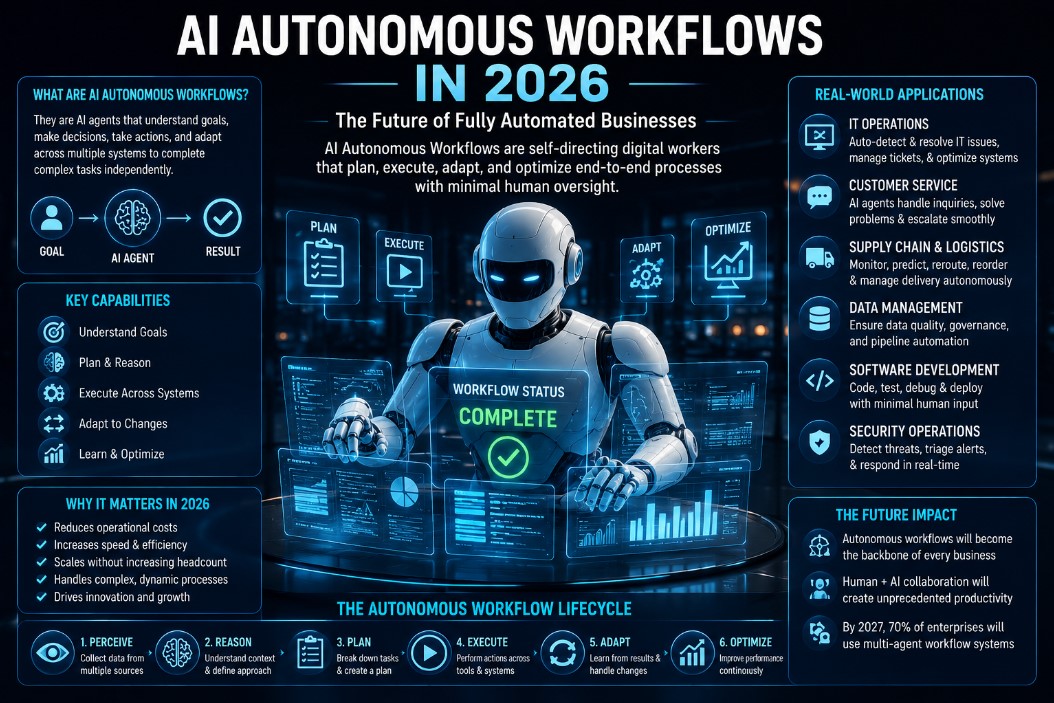
The Dawn of Truly Self‑Directing Automation
Imagine handing a complex task to your software and watching it get done end‑to‑end, with no rules to code, no scripts to maintain, and no human frantically babysitting each step. This isn’t a science‑fiction dream. In 2026, AI autonomous workflows are becoming the new normal in forward‑looking enterprises.
An autonomous workflow isn’t just another automation tool. It’s a self‑directing digital worker—an AI agent that can understand a goal, devise a plan, execute multi‑step operations across different systems, adapt when things go wrong, and only ask for help when it truly needs it. As one source notes, autonomous AI agents are intelligent systems designed to plan, reason, decide, and act independently in pursuit of defined goals, executing multi‑step workflows and adapting based on context.
This guide explores everything you need to know about AI autonomous workflows in 2026: what they are, why they matter, how they’re being used, and the challenges you’ll face implementing them.
What Are AI Autonomous Workflows?
At their core, AI autonomous workflows represent a departure from traditional automation. Traditional robotic process automation (RPA) follows hardcoded rules; autonomous workflows combine AI, machine learning, and flexible orchestration to execute complex processes with minimal oversight.
Unlike rule‑based automation, which breaks when a process changes, autonomous workflows:
- Perceive their environment (via APIs, data feeds, logs)
- Reason about goals and constraints
- Plan a sequence of actions
- Execute those actions using tools such as APIs, code interpreters, or web browsers
- Learn from outcomes and adapt over time
The result is a workflow that evolves with your business, rather than becoming obsolete every time a form field moves or a policy updates.
Key Forces Driving Adoption in 2026
Why has 2026 become the breakout year for AI autonomous workflows? Three major trends converge:
The Shift from Generative AI to Agentic AI
Generative AI was about answering questions. Agentic AI is about achieving goals. Autonomous agents now act as digital labor, handling entire business processes with limited human involvement. This shift moves AI from a suggestion engine to an execution engine.
The Transition from Rule‑Based to Autonomous Execution
Traditional automation relied on static logic that required constant human updates. That model no longer scales. AI autonomous workflows combine AI and ML to handle judgment‑intensive tasks, compliance interpretation, and cross‑system coordination—tasks that previously required human workers.
The Evolution of Governance and Observability
Enterprises are moving from treating AI as an experiment to running it as a system of record. According to a Futurum Group survey, agentic AI has become the fastest‑growing enterprise tech priority, with 39.3% of organizations ranking it among their top three strategic initiatives, up from 32% in late 2025.
Real‑World Applications
AI autonomous workflows are already transforming critical business functions:
IT Operations and Service Desk
Large IT organisations are deploying autonomous AI specialists that function like teammates. A Level 1 Service Desk AI can analyze incoming tickets, investigate root causes, and auto‑resolve common issues without human intervention. For example, Tanium and ServiceNow have launched autonomous IT products that connect real‑time endpoint data with workflow automation, enabling IT teams to identify and fix issues without manual steps.
Customer Service and Support
Autonomous agents now triage, solve, and escalate customer cases across multiple channels, freeing human agents for higher‑value interactions. This marks a fundamental shift from AI as a recommendation engine to AI as a frontline worker.
Supply Chain and Logistics
FedEx and ServiceNow have partnered to create AI‑powered supply chain solutions that improve customer workflows and make logistics smarter. Autonomous agents can monitor inventory, trigger reorders, reroute shipments in response to delays, and reconcile invoices—all without human supervision.
Data Management and Governance
Enterprises are deploying multi‑agent systems to manage data quality at scale. Informatica built a multi‑agent AI system to reduce data workflows, allowing users to explore tasks conversationally or execute them in context. Similarly, Acceldata integrated data quality checks directly into AI agent workflows, ensuring that autonomous systems only consume data that meets business thresholds.
Engineering and Development
At events like MATLAB EXPO 2026, engineers showcased how AI autonomous workflows are moving from experimentation to production, with AI agents integrated into model‑based design, virtual vehicle development, and automated driving systems. In software engineering, autonomous agents now handle everything from code generation to bug fixes, testing, and deployment.
Security Operations Center (SOC) Automation
Security teams are deploying AI agents to automate alert triage, streamline SOC workflows, and reduce data ingestion costs. AgentSkope (from Netskope) allows agents to autonomously gather data, triage risks, and initiate workflows such as creating service tickets or notifying analysts.
The Multi‑Agent Shift
While a single AI agent can be powerful, the real potential of AI autonomous workflows lies in multi‑agent collaboration. As AI agents move from isolated assistants to teams of autonomous digital workers, coordination and governance become paramount.
Specialised agents with narrow, focused tasks run more reliably than a single AI trying to execute a massive, multi‑step prompt. An enterprise might use separate agents for security, customer support, and data quality, each communicating through secure protocols. By 2027, 70% of multi‑agent systems are expected to contain agents with narrow, focused roles, dramatically improving accuracy.
The Governance and Control Layer
Deploying AI autonomous workflows at scale requires rethinking control. Four mechanisms are emerging:
- Golden paths – Preferred workflows that agents are encouraged to follow
- Guardrails – Hard boundaries agents cannot cross (e.g., cannot initiate wire transfers without approval)
- Safety nets – Mechanisms to roll back erroneous actions
- Manual review workflows – Human‑in‑the‑loop for high‑stakes decisions
According to a CNCF forecast, these four control mechanisms will define the enterprise shift to autonomy in 2026.
Major Challenges and How to Overcome Them
Reliability Is Not Guaranteed
An AI agent that works 99% of the time can still cause disaster when it fails. Complex, multi‑step workflows cannot be “tested” like traditional software; they must be reviewed like human work.
Solution: Use agent harnesses that mimic production environments, incorporate human‑in‑the‑loop for critical actions, and build rollback capabilities.
Evaluation and Observability
Traditional metrics (uptime, error rates) are insufficient for autonomous agents. You need to evaluate whether a workflow completed its objective, how efficiently it used resources, and whether it stayed within guardrails.
Best practice: Manage the full AI agent lifecycle—build, test, deploy, and scale—using tools that provide audit trails, visual editing, and outcome‑based monitoring.
Operational Risks at Scale
“Production agents are autonomous actors that can execute code and spend money. They must be treated with the same scrutiny as an external user.” A single error in an autonomous workflow (e.g., misclassifying an invoice) can propagate silently through downstream systems, corrupting financial records.
Solution: Implement strict access controls, transaction limits, and secondary verification for high‑impact actions.
Governance Gaps
Only 18% of security leaders believe their identity and access management systems can effectively manage AI agent identities. As AI autonomous workflows scale, robust identity and permission management becomes critical.
Solution: Assign each agent a verifiable identity with least‑privilege access.
Human‑AI Trust
For AI autonomous workflows to succeed, humans must trust their digital colleagues. This trust is earned through reliable, context‑aware execution that explicitly balances speed, diagnostic quality, and operational cost under real production constraints.
The Platform Ecosystem
Numerous platforms support AI autonomous workflows. The best AI workflow automation tools for 2026 include Kore.ai, Moveworks, Automation Anywhere, ServiceNow, UiPath, Glean, Microsoft, and Zendesk.
- ServiceNow offers Autonomous Workforce capabilities, with AI specialists for IT, security, and risk.
- Teradata launched the Autonomous Knowledge Platform, providing a single environment for building, deploying, and governing AI tools and data workflows.
- NVIDIA provides accelerated infrastructure and AI frameworks for running long‑running autonomous agents, while many open‑source frameworks enable custom agent development.
2026 Goals and 2027 Projections
Experts agree on four strategic goals for 2026: operationalising agentic AI with discipline, leading responsibly, innovating boldly, and delivering measurable impact beyond pilots.
- By 2026, 70% of organizations will adopt composite AI, blending generative, prescriptive, predictive, and agentic technologies.
- By 2027, half of all enterprises will redefine human‑AI collaboration through agentic AI, and 65% of cities will deploy AI agents across systems to orchestrate end‑to‑end workflows.
- People may eventually delegate half of their daily work to autonomous systems.
Frequently Asked Questions
Q1: What is the difference between RPA and AI autonomous workflows?
RPA follows predefined rules; autonomous workflows adapt, learn, and handle judgment‑intensive tasks without constant reprogramming.
Q2: How do I start implementing AI autonomous workflows?
Start with a high‑volume, rules‑heavy process that has clear success metrics. Pilot a single agent, measure outcomes, then expand to multi‑agent collaboration.
Q3: What skills does my team need?
Beyond traditional RPA, you’ll need prompt engineering, API integration, and AI agent orchestration expertise.
Q4: Are AI autonomous workflows safe?
Safety depends on design. With guardrails, identity management, and human‑in‑the‑loop for high‑risk actions, they can be safer than manual processes prone to human error.
Q5: How do I measure ROI?
Track time saved, error reduction, throughput increase, and cost per transaction. Also measure unquantifiable benefits such as 24/7 operation and improved employee satisfaction.
Conclusion
AI autonomous workflows are no longer a pilot program. They are a strategic imperative for 2026 and beyond. By shifting from static rules to adaptive, self‑directing agents, enterprises can automate processes that previously required judgment, creativity, and cross‑system coordination.
The journey from experimentation to production requires thoughtful governance, robust observability, and a culture that embraces human‑AI collaboration. But the rewards are clear: faster operations, lower costs, reduced errors, and the ability to scale without proportionally increasing headcount.
As you plan your 2026 automation roadmap, ask yourself: which of your current workflows would benefit most from genuine autonomy? The answer may define your competitive advantage for years to come. Curious about how AI is reshaping the browser itself? Read our in‑depth article on AI Browsers to see the next frontier of intelligent web interaction.